
This is a short story, rather than a blog. It takes place in the world of my novel, Shadows and Light: Journeys of a Spirit Healer, the first book in a five-book series. The story occurs a few years after Book 1 ends. Since this is a full story, it’s longer than my usual entries.
Grrrraugh…Grrrraugh….Grrrraugh.
The guttural sound came loud and deep, vibrating in her chest and raising the hairs on her arms. Fear enveloped her, but instead of screaming, she sat frozen. Where was the sound coming from? Her gaze darted to the forest a hundred feet to her left, searching for movement. It was rare for beasts to charge into the village, but it did happen. A wild boar had gored a young man last spring.
Why hadn’t anyone in the house rushed outside? Then again, with how loud her family was, her father especially, they probably hadn’t even noticed. Heart pounding, Nuvanyaa scanned the ground for a weapon. A tree branch, a large rock, anything. But there was nothing. The flat bench on which she sat offered little protection. She was about to flee inside when, out of the corner of her eye, she caught movement in the sky above her.
“A skyborne?” she uttered in disbelief. In fact, there were two. One chasing the other. Then she noticed a third, much larger and farther behind, its deep growl unmistakably the source of the earlier sound. She exhaled with relief.
Skybornes didn’t attack humans, according to the village shaman, Qaum’tuk’e. She had once explained that they possessed great wisdom, regularly leaving their nest within Ikuma’Morr, the mountain range west of the village, to offer guidance to any who sought it. But, long ago, humans dealt them a great insult, and since then, the skybornes have kept their distance. Nuv could hold a grudge, but never that long. She wished they’d forgive humans and break their silence, at least with her.
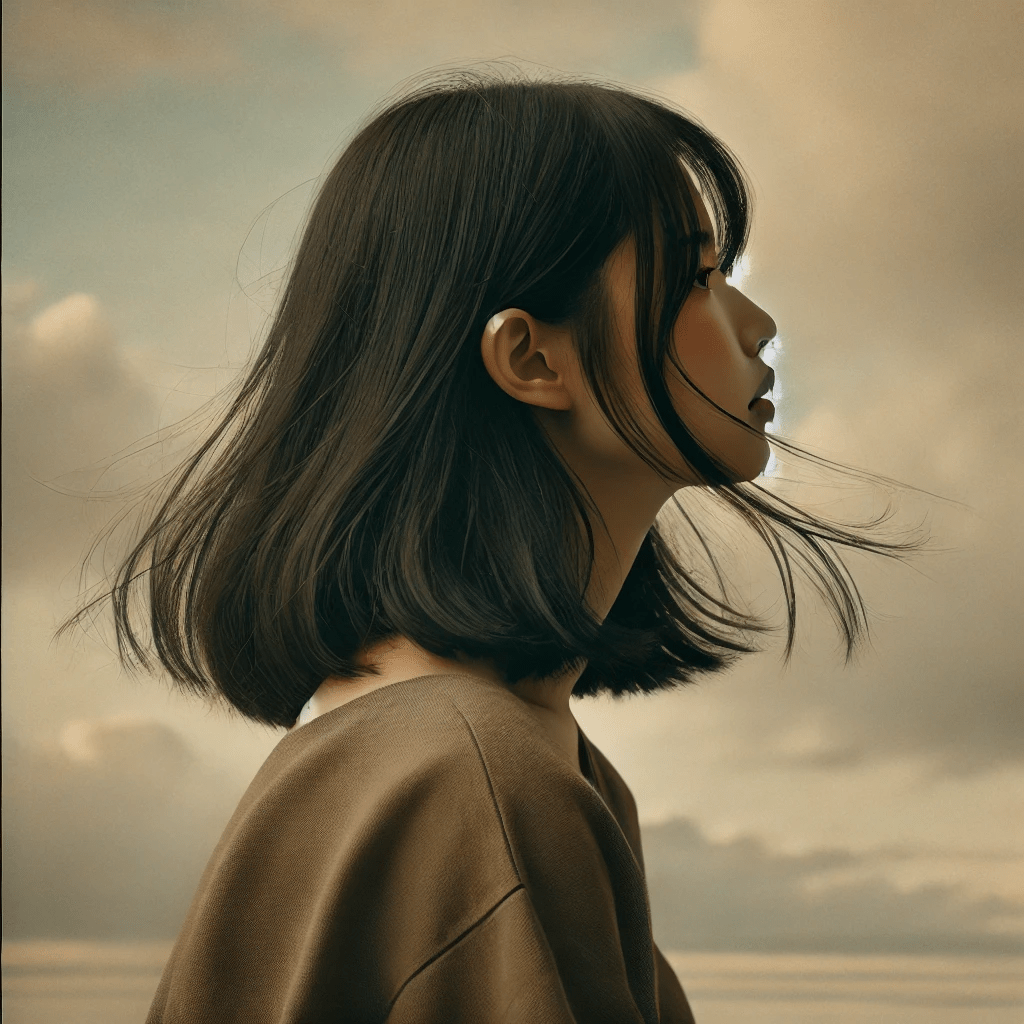
Reseating herself on the bench, Nuv, as she preferred to be called, watched as they winged out of sight, a gust of wind blowing her shoulder-length black hair every which way. Wouldn’t it be something to fly free like the skybornes? Unlike her, who felt tethered. But that was impossible, brushing away the tangled strands that clung to her face in irritation. Nuv bemoaned not having shorter hair like the village boys. Her Ana’a—mother in her people’s language—wouldn’t allow it. Most wouldn’t expect such a forceful will from a woman barely 4 foot 11, with dark brown hair and a slight frame. Defying her was nearly impossible. The thought settled like a heavy weight on Nuv’s chest, dulling the momentary excitement of seeing the skybornes.
Her unhappiness had driven her outside to her mother’s garden today, her 17th birthday. Even the vibrant flowers before her, the pink, yellow, and red tulips that were her mother’s favorite, and the purple and white lilies, her own, couldn’t lift her spirit. A few years ago, when Ana’a proposed planting a garden, she suggested Nuv mix the colors, creating a rainbow effect, rather than arranging them by type. It had always struck her as odd, given how much Ana’a valued order in other areas of life. At the moment, the effect felt colorless.
As was their custom for special occasions, at noon supper, her family celebrated her birthday. As they enjoyed the carrot cake Ana’a had prepared, her younger sister, Laniiyaa, brought out their parents’ gift—another floor-length tunic that Ana’a had made, trimmed with flowers and hearts. Lani had exclaimed, “Isn’t it beautiful, Nuvanyaa? Pushing her long dark brown hair away from her almost cherubic face, Lani placed the tunic in front of Nuv. “Ana’a, even let me stitch the hearts around the collar.”
The tunic was beautiful, and Lani’s hearts were perfect—a testament to her skill as a seamstress at just thirteen. But regardless of its quality, Nuv felt uncomfortable wearing similar tunics. She preferred shorter tunics with pockets, like her brother, Maniituk’e. Mani was four years older and took after their father, muscular, tall, with a square jaw. Nuv bore the same jawline and height but had a slight frame, like Ana’a.
Next to Nuv on the bench was Mani’s letter. He had written that he probably wouldn’t be here for the celebration. It saddened her, but she understood. He lived with his wife on her family’s farm in the land south of them, Docha-leigh. He had moved away less than a year earlier. She wished he’d been able to come. She’d have talked to him again about her unhappiness. While Mani didn’t always understand, he listened.
Beside the letter lay a carving tool and a small block she’d begun whittling. Nuv didn’t know what shape would emerge, what her Ata’a called its form. Like him, she let the wood speak in its own way, adjusting with each cut. She loved running her fingers over each piece of wood, discovering its unique texture, from smooth and yielding to dense and firm. That sounded strange to some. Lani, for example. But Ata’a understood. As the village carpenter, his business was making furniture. Occasionally, for himself or as a gift, he carved animals like a bird, fox, or bear. Ana’a sometimes complained that it was a waste of time and wood, calling it foolish. But Ata’a would shrug, insisting it kept his hands nimble.
Nuv smiled, remembering how Ata’a praised his eldest daughter’s wood skill to one of his customers. Working with wood was unusual for a girl, but he encouraged it. She and Ata’a had even created the bench she sat on. She recalled the day he suggested they create it together.
The previous autumn, she’d been sitting on the ground next to the garden, enjoying the unseasonably warm weather after spending an hour removing dead flowers. She had worn the long tunic her Ana’a had insisted on, the one with butterflies around the collar, lace cuffs, and a pink bow on each shoulder. She maintained that the style would attract a proper mate.
It was grotesque. And she wanted nothing to do with anyone who found it appealing.
By the time Nuv finished her work, dirt and mud covered the tunic, especially from the waist down. Somehow, she’d even torn a cuff. She hoped that when Ana’a saw her filthy tunic, she’d finally agree that a shorter tunic was more practical. That didn’t happen. Instead, Ana’a scolded her for not being more careful, pulled the tunic off her, and declared, rather theatrically, that she and Lani could restore it to its pristine condition. That reaction only made Nuv feel more estranged. If Ana’a knew the truth about her, feeling a quiver in her stomach, how would she…?
Looking down at the new bench again, she recalled Ata’a’s question when they planned the project. ‘Nuv, what wood should we use?’ Besides Mani, Ata’a was the only one in her family who called her Nuv. Would he understand if she told him?
Soon after her brother moved away, Ata’a had asked her to spend more time with him in his carpenter shop. Working more with wood and being with Ata’a’s brought her some comfort. But Ata’a had rules. Two of the most important were arriving on time and not ‘daydreaming,’ as he mistakenly called her unhappiness. Ana’a had frowned at the request, determined as she was to train Nuv as a seamstress like herself. Nuv wasn’t sure why. She wasn’t good at it. And she hated it. But neither of those things mattered, despite the number of times Ana’a had to repair Nuv’s mistakes.
It made no sense.
Ana’a kept repeating that every woman had to know how to sew, going on and on about how nice it would be if they started a business together. Nuv kept reminding her that Lani was a better choice. But Ana’a insisted it had to be her, now that she was approaching marriageable age.
Back to Ata’a’s question, Nuv looked down at the bench: western red cedar. She knew it had been a test. When she named this hardwood, he had smiled approvingly and said, ‘Good choice.’ She had chosen it because she knew it was durable enough to withstand harsh weather, like the huge snowstorm they had last winter.
His praise had warmed her then. Now, it did little to dispel how lonely she felt.
It all started four years ago. One morning, Nuv woke up to find blood on her sheets. Ata’a told her it was her first moon-blood experience and pointed out that her chest was also growing. Nuv responded with tears.
Ata’a misunderstood, believing they were happy tears about finally becoming a woman, which only made her cry harder. Her body was betraying her.
From then on, every month brought another episode. Ana’a provided her with small pieces of cloth to wear under her clothing when her time neared, in case it happened unexpectedly. These episodes were wrong. They shouldn’t be happening. It wasn’t happening to the boys her age in the village.
Nuv had spent her time off playing with them—climbing trees, exploring, and occasionally getting into mischief—until she accidentally told Ana’a, who put a stop to it. Months later, following an episode, she was so upset about the changes that she climbed to the top of a cliff outside their village to…
Nuv, a voice said in her head.
Did her Ata’a just call her? The voice sounded male. But it couldn’t be Ata’a. After her party, he had to make a delivery of a teak trunk to an insistent and wealthy customer on the other side of the village.
Nuv, the voice repeated more loudly.

Iosef? Nuv mind-spoke,chagrined she hadn’t recognized his voice right away. Iosef, her guardian angel, first made himself known to her that afternoon at the cliff, when a white feather drifted down from an empty sky with no birds in sight.
Indeed. I’ve been watching you sitting there, and I know you’re unhappy.
Surely, that’s no surprise. You know I’ve felt this way a lot since my body started changing.
I do. I had hoped that working in your Ata’a’s shop more would have brought you some joy.
It does. Or it did. But then Ana’a had to give me another girly tunic today.
I saw.
I was so hurt that I ran out as soon as I could after the cake.
How can I help? Iosef asked, sympathetically.
Can you make me a boy? I know you can’t. But why was I born a girl if I feel like a boy inside?
That’s a tough question. It’s the first time you asked me that.
I’ve thought about it enough.
I’m glad you finally asked. Let me ask you something first.
OK, she mumbled.
Have you ever wondered whether it has something to do with your life’s purpose?
You mean to feel alone? To be laughed at, taunted, and sad all the time?
So, you’re angry and unhappy. He paused before continuing. Does this still have something to do with the boy you saw weeks ago?
Nuv sat quietly, recalling the incident. Her Ata’a had asked her to get resin glue from a crafter with a shop on the main road. She had just stepped out of the shop when she saw some entitled village sons chasing Seavuuk, hurling curses at him. Even calling him ‘it.’ She hid around the corner of a nearby building, too afraid to intervene. The boys shouted that they’d catch him the next time, and then he’d be sorry.
Nuv only barely knew him, but he usually wore long tunics like Ana’a made for her. Ana’a had admired them at the weaver shop where he worked. But after praising the craftmanship, she added that such were not appropriate for men.
Iosef remained silent, allowing Nuv time to reflect.
At last, Nuv mind-spoke, Yeah, I guess it’s related. After a pause, she added, I still can’t believe he wore them in public.
That took courage.
When I’m in public, I try to remember to wear a scarf over my head to cover my shorter hair. Yesterday, I heard that Seavuuk’s parents turned him out, and that he hadn’t shown up for work. Do you think he is… like me?
I would imagine so.
Where do you think he went?
Most likely, somewhere people would treat…her…kindly. Or at least not reject her.
I hope so, Nuv replied wistfully. Some called Seavuuk a freak. Is that what I am?
No. I’m sorry you even thought that. In your world, I’ve heard that people like you call themselves shiftwoven.
“Shiftwoven,” Nuv repeated, rolling the word over in their mind. It felt… right. I like that. But the thought of saying it aloud to people—of claiming it—sent a surge of terror through her. Am I a coward by not telling my parents?
Absolutely not. It took courage to tell your brother.
I was scared before I told him, but I knew he loved me. I could handle that. But telling my parents? Or the village? That’s terrifying.
I understand. It’s a new idea for people of your period. You’ll know when it’s time. Trust your instinct.
But why me? Nuv asked, silent again. I wish you were sitting next to me. It would mean so much to have you hold me. Would I even be able to do that?
Let me answer your last question first. That can happen if you visit the divine realm while sleeping.
Really? How?
Before you go to sleep tonight, hold that as your intention.
I will. I promise, feeling a flicker of hope.
Now, to your ‘why me’ question. May I speculate?
OK.
What if the struggles you’re going through could help another person deal with the same thing?
I don’t know how. I didn’t stand up for Seavuuk.
You weren’t in a place where you could do that. Not yet. But one day, you’ll come upon another and can listen to their pain as I and your brother listen to yours.
Maybe, Nuv considered, . She did like helping people. She loved watching Ata’a’s customers’ faces light up when they saw the wardrobe or bedstead he created for them. Bringing flowers to village widows also gave her joy. But is my entire life meant for others? I mean, does it all have to be about suffering?
Ah. My mistake, Iosef replied. Your life should also have play, fun, and joy. Without those, how could you truly help others like you?
Thanks for telling me. I haven’t had a lot of fun lately.
I know it’s difficult. I’m here for you, as are others in this realm. Even your ancestors, like your Ana’a’s Ana’a. They’re very proud of how strong you’ve been.
I don’t feel strong. But that helps a little, I guess, Nuv said, sighing. But it’s not the same…
What about your brother?
What about him?
Isn’t that him coming up the path?
“Mani!” Nuv screamed with delight, when she saw him and his wife, Iluugta. Running toward them, she threw herself into his arms, holding him tightly.
Mani chuckled. “That’s some greeting.” Pulling away moments later, he said, “Sorry we missed the celebration. We planned to arrive this morning, but Iluu had morning sickness.”
“Do you mean, she’s…?”
“Yes,” Iluu answered. “Mani was so worried about you—and about the gift Ana’a might give you that I insisted we make the trek.”
“Does that mean…you know?” Nuv cautiously asked.
“Yes. I don’t understand either, but know that I love you.”
“What if the three of us take a walk along the stream tomorrow, and you can tell us what’s going on?” Mani suggested.
“Oh, please,” Nuv said, hugging her brother again, before embracing her sister-in-law. “And congratulations!”
“We’d better get inside,” Mani advised. “Ata’a, Ana’a, and Lani probably heard you scream.”
As Nuv followed them toward the front door, she smiled, whispering, “Thanks, Iosef.”
If you liked this blog and are interested in receiving an email for future blog posts, enter your email in the field below and click Subscribe.

 Remember Your Divine You